
By Max D., MBA | GOOD ROOF WORX
Vaulted ceilings trap moisture without ventilation. See how re-engineered airflow prevents mold and prepares you for a smarter roof replacement.
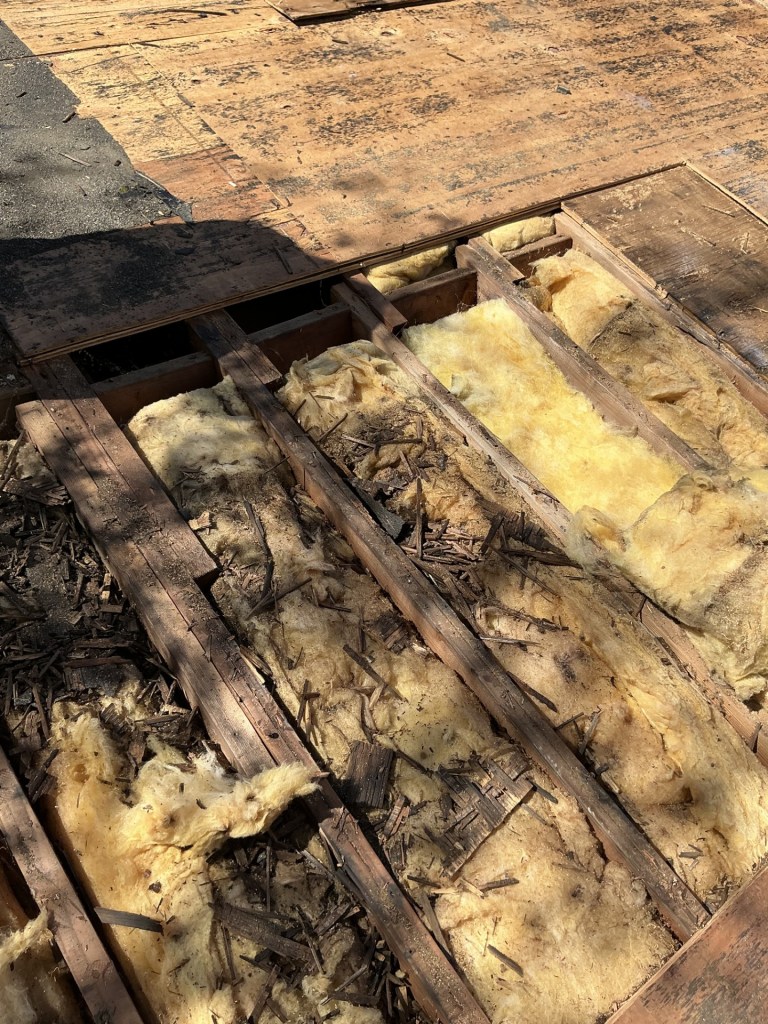
A Northern California home with a vaulted (“cathedral”) ceiling was experiencing persistent moisture problems. Insulation had been installed tightly to the roof sheathing, eliminating any airflow path, so warm, moisture‑laden air became trapped in the rafter bays. Over time, the underside of the roof deck showed staining and localized mold. The building‑science diagnosis was straightforward: the assembly lacked a continuous, low‑to‑high ventilation channel and the code‑required clearance between insulation and sheathing that keeps roof decks dry in vaulted ceilings. California’s Residential Code (CRC) requires cross‑ventilation of enclosed rafter spaces and prescribes minimum net‑free area; widely used local guidance also calls out the minimum 1‑inch airspace between insulation and roof sheathing in these assemblies.
Regional Moisture Drivers in Northern California
Across microclimates in your service region, ordinary weather can quietly load roof cavities with moisture. In the Bay Area, recurring marine layers and night cooling frequently chill roof decks while indoor air remains humid; when ventilation pathways are blocked, condensation risk rises at the underside of the sheathing. The California Energy Commission’s climate‑zone tool (Title 24) is the go‑to reference for scoping projects across these microclimates. In the Sacramento Valley, winters often bring tule fog—a persistent radiation fog unique to the Central Valley—driving repeated wetting cycles that demand reliable purge air in roof cavities. In the Lake Tahoe/Truckee region, long, cold seasons and snow cover keep roof decks cold for extended periods, so uninterrupted eave‑to‑ridge ventilation is essential—not only for moisture, but also for WUI (wildfire) compliance when vents are used.
What the Assessment Showed
Inspection identified two core issues: insulation was pressed against the sheathing with no baffles or clearance, and there was no continuous intake‑to‑ridge pathway. These conditions are consistent with field and lab findings over the past decade: poorly vented or unvented roof spaces retain higher relative humidity (RH) at the sheathing, higher wood moisture content, and higher modeled mold index than assemblies with continuous airflow. (1)
Code & Design Drivers
The CRC requires cross‑ventilation for enclosed rafter spaces and sets minimum vent areas. Local building handouts used throughout California explicitly call for a minimum 1‑inch airspace between insulation and the roof sheathing in cathedral ceilings to preserve that airflow path.
The Solution
The solution was to raise the roof deck by roughly one inch to create a continuous airspace above the insulation and below the new sheathing. This re‑engineering involved removing the shingles and existing decking, sistering new rafter members to maintain a uniform ventilation channel, and then re‑decking. The design established uninterrupted intake at the eaves and a continuous exhaust slot at the ridge, sized for balanced net‑free area, and—where applicable in the Tahoe WUI—specified ember‑resistant ridge and eave components compliant with current California requirements. Manufacturer installation instructions were followed for the ridge and intake components, including the single‑exhaust principle at the ridge and the use of an engineered edge‑intake where soffits were absent.
Results
Once the 1‑inch airspace and end‑to‑end vent path were in place, the conditions that sustained mold growth were broken. Recent full‑scale field studies of ventilated attics show lower average RH and near‑zero mold indices when continuous airflow is maintained; complementary hygrothermal simulations reach the same conclusion for moisture‑safe roof sheathing. Dynamic mold‑growth modeling (DR‑SIM) further explains the result: by keeping the sheathing surface below the temperature‑dependent critical RH curve, growth stalls and reverses. The re‑engineered assembly also supports shingle longevity and comfort by limiting extreme deck temperatures, and CFD work on ridge vents reinforces the importance of proper ridge geometry and continuous buoyancy‑driven flow. (2)(3)(4)(5)
Why This Approach Works
Multi‑year measurements and controlled studies now document the link between continuity of airflow and durable moisture performance in attics and cathedral ceilings. Vented assemblies with reliable intake and exhaust consistently keep wood moisture and RH lower than obstructed or unvented equivalents—even in cold climates—and modern analyses show that wood durability tracks strongly with moisture exposure. Incorporating these findings into Northern California detailing (balanced intake/exhaust, code‑compliant airspace, and WUI‑compliant vent products where required) turns a chronic moisture problem into a stable, durable assembly. (6)(7)(8)
For a custom solution, we are your local roofing company-GOOD ROOF WORX. Feel free to schedule an in‑home consultation for your roof replacement project.
References
1. Ge, H., Wang, R., & Baril, D. (2018). Field measurements of hygrothermal performance of attics in extreme cold climates. Building and Environment, 134, 114–130. https://doi.org/10.1016/j.buildenv.2018.02.032
2. Valovirta, I., Hietikko, J., Tuominen, E., Yletyinen, K., & Vinha, J. (2024). Hygrothermal performance of ventilated attics: A field study in cold climate. Building and Environment, 266(112114), 112114. https://doi.org/10.1016/j.buildenv.2024.112114
3. Wang, R., Ge, H., & Baril, D. (2020). Moisture-safe attic design in extremely cold climate: Hygrothermal simulations. Building and Environment, 182(107166), 107166. https://doi.org/10.1016/j.buildenv.2020.107166
4. Boardman, C. R., Glass, S. V., & Lepage, R. (2023). Dose-response simple isopleth for mold (DR SIM): A dynamic mold growth model for moisture risk assessment. Journal of Building Engineering, 68(106092), 106092. https://doi.org/10.1016/j.jobe.2023.106092
5. Chen, C.-M., Lin, Y.-P., Chung, S.-C., & Lai, C.-M. (2022). Effects of the design parameters of ridge vents on induced buoyancy-driven ventilation. Buildings, 12(2), 112. https://doi.org/10.3390/buildings12020112
6. Jensen, N. F., Bjarløv, S. P., Johnston, C. J., Pold, C. F. H., Hansen, M. H., & Peuhkuri, R. H. (2020). Hygrothermal assessment of north-facing, cold attic spaces under the eaves with varying structural roof scenarios. Journal of Building Physics, 44(1), 3–36. https://doi.org/10.1177/1744259119891753
7. Brischke, C., & Alfredsen, G. (2020). Wood-water relationships and their role for wood susceptibility to fungal decay. Applied Microbiology and Biotechnology, 104(9), 3781–3795. https://doi.org/10.1007/s00253-020-10479-1
8. Libralato, M., De Angelis, A., Saro, O., Qin, M., & Rode, C. (2021). Effects of considering moisture hysteresis on wood decay risk simulations of building
Leave a Reply