
By Max D., MBA | GOOD ROOF WORX
Attic mold and premature roof failure often trace to poor attic ventilation. Understand how moisture builds up so you can plan a smarter, longer-lasting roof replacement.
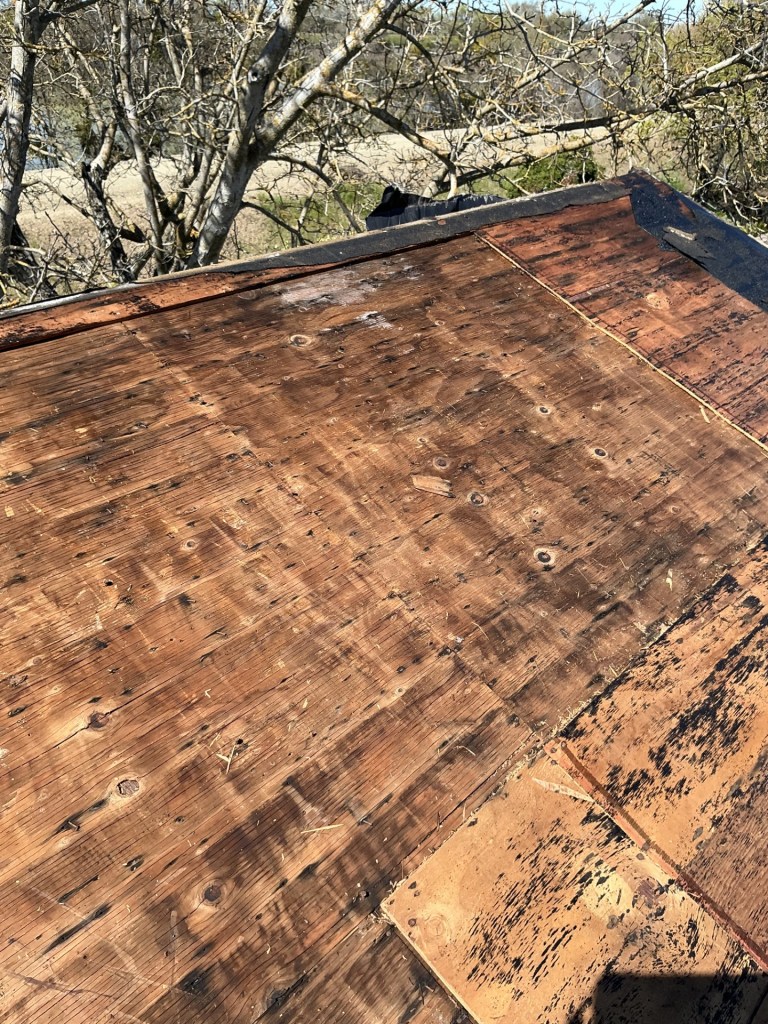
A homeowner reported unexpected leaks on a ~10‑year‑old asphalt‑shingle roof. As a musty odor appeared, the family began experiencing allergy‑type symptoms; inspection revealed visible mold on the attic’s plywood decking. The attic had no eave (soffit) or ridge vents, so hot, moisture‑laden air was trapped against the roof deck. The remedy installed was continuous intake and exhaust “SmarVents,” with baffles to keep a clear air pathway from eaves to ridge, plus selective replacement of mold‑compromised roof/wood components.
Why This Happens Here—and How to Think About It as a Homeowner
In the Bay Area, the Sacramento Valley, and the Lake Tahoe–Truckee region, everyday weather can quietly load your attic with moisture—coastal marine layers and fog around San Francisco, Oakland, and San Jose; big day–night temperature swings and winter tule fog in the Sacramento area; and cold nights with stormy winters in Tahoe.
When an attic doesn’t breathe, that moisture has nowhere to go. Humidity builds under the roof, the wood decking stays damp beyond a safe range, and mold finds an easy foothold. How much fresh air your attic gets really matters: steady, moderate airflow keeps average humidity low and mold risk down, while blocked or missing vents push risk up. Ventilation isn’t just about cooling a hot attic; it’s about moving moisture out. Air that comes in at the soffits and exits at the ridge carries water vapor away from the roof deck so it can dry—especially important if small leaks from the house are feeding moisture into the attic.
Mold typically begins when air at the roof deck stays very humid for long enough—roughly when relative humidity lingers around 70–85%, depending on temperature. Keep it below that window and mold can’t take hold; lower it again and growth stops. A musty attic can also affect the family below because dampness and mold are linked with allergy and asthma flare‑ups, and even though the attic isn’t a living space, odors and particles can be pulled into rooms through air leaks and pressure differences. Finally, wet wood weakens over time; if parts of the plywood or OSB become soft, start to delaminate, or are heavily colonized by mold, replacing those sections after fixing the moisture problem restores strength and helps your roof last longer.
Without ventilation, humidity builds up under the roof. Wood stays damp (often above the “safe” zone), which lets mold grow.
Bottom line: In our Bay Area–Sacramento–Tahoe climate, the fix we installed—balanced, continuous soffit‑to‑ridge ventilation with clear baffles, plus targeted replacement of compromised wood—directly lowers roof‑deck humidity, drives the mold index toward zero, and aligns with what field measurements and peer‑reviewed models show reduces risk. (2)(4)
Research Findings
Moisture buildup without ventilation drives high relative humidity (RH) at the roof deck, enabling mold. Field studies comparing vented vs. unvented attics show that the unvented/poorly vented cases retain high wood moisture content (often >20%) and persistently higher RH at the sheathing—conditions repeatedly associated with mold risk. In a Building & Environment field study of three houses in sub‑arctic Canada, vented attics maintained acceptable conditions while the unvented attic’s framing stayed >20% MC even through summer, indicating inadequate drying. (1)
Attic ventilation rate is directly tied to mold risk.A 2024 full‑scale field study (six purpose‑built test attics) found that moderate, reliable air‑change rates in ventilated attics produced the lowest average RH and lowest mold indices; snow/obstructions that reduce airway continuity increased risk—underscoring the need for continuous, unblocked intake‑to‑ridge paths. (2)
Design focus should be removal of moisture at the roof deck (not just heat relief). Parametric hygrothermal analyses in very cold climates conclude that unvented attics carry greater moisture and mold risk, and that ventilation is required to achieve “moisture‑safe” performance of the roof sheathing—especially where indoor air leakage adds moisture to the attic cavity. (3)
Mold growth threshold science. Recent building‑physics modeling translates roof‑deck surface temperature and RH into a time‑dependent mold index: sustained RH above a critical curve (≈70–85% depending on temperature) allows mold to initiate and progress; keeping conditions below that line arrests growth. This offers a rigorous link between lowering attic RH via ventilation and reducing the modeled mold index to near zero. (4)
Health relevance (why the musty attic mattered). High‑quality reviews and meta‑analyses over the last decade associate indoor dampness/mold with asthma exacerbations and allergic rhinitis; while an attic is outside the occupied zone, moisture problems aloft often co‑occur with air leaks/pressure pathways, and remediation that removes moisture sources and visible fungal growth is consistent with evidence‑based health protection. (5)(6)
Wood durability requires keeping the deck dry. Contemporary reviews show that elevated wood moisture drives fungal metabolism and eventual structural degradation; where plywood/OSB is visibly colonized or softened, removal and replacement is the prudent durability measure once moisture control is established. (7)(8)
For tailored guidance, we are your local roofing company-GOOD ROOF WORX. Feel free to schedule an in‑home consultation for your roof replacement project.
References
1. Ge, H., Wang, R., & Baril, D. (2018). Field measurements of hygrothermal performance of attics in extreme cold climates. Building and Environment, 134, 114–130. https://doi.org/10.1016/j.buildenv.2018.02.032
2. Valovirta, I., Hietikko, J., Tuominen, E., Yletyinen, K., & Vinha, J. (2024). Hygrothermal performance of ventilated attics: A field study in cold climate. Building and Environment, 266(112114), 112114. https://doi.org/10.1016/j.buildenv.2024.112114
3. Wang, R., Ge, H., & Baril, D. (2020). Moisture-safe attic design in extremely cold climate: Hygrothermal simulations. Building and Environment, 182(107166), 107166. https://doi.org/10.1016/j.buildenv.2020.107166
4. Boardman, C. R., Glass, S. V., & Lepage, R. (2023). Dose-response simple isopleth for mold (DR SIM): A dynamic mold growth model for moisture risk assessment. Journal of Building Engineering, 68(106092), 106092. https://doi.org/10.1016/j.jobe.2023.106092
5. Caillaud, D., Leynaert, B., Keirsbulck, M., Nadif, R., & mould ANSES working group. (2018). Indoor mould exposure, asthma and rhinitis: findings from systematic reviews and recent longitudinal studies. European Respiratory Review: An Official Journal of the European Respiratory Society, 27(148), 170137. https://doi.org/10.1183/16000617.0137-2017
6. Cai, J., Yang, M., Zhang, N., Chen, Y., Wei, J., Wang, J., Liu, Q., Li, W., Shi, W., & Liu, W. (2024). Effects of residential damp indicators on asthma, rhinitis, and eczema among children: A systematic review and meta-analysis of the literature in the past 33 years. Building and Environment, 251(111226), 111226. https://doi.org/10.1016/j.buildenv.2024.111226
7. Brischke, C., & Alfredsen, G. (2020). Wood-water relationships and their role for wood susceptibility to fungal decay. Applied Microbiology and Biotechnology, 104(9), 3781–3795. https://doi.org/10.1007/s00253-020-10479-1
8. Libralato, M., De Angelis, A., Saro, O., Qin, M., & Rode, C. (2021). Effects of considering moisture hysteresis on wood decay risk simulations of building envelopes. Journal of Building Engineering, 42(102444), 102444. https://doi.org/10.1016/j.jobe.2021.102444
Leave a Reply