
By Max D., MBA | GOOD ROOF WORX
By understanding why the self-seal strip sometimes fails, homeowners can better prepare for a resilient roof replacement.
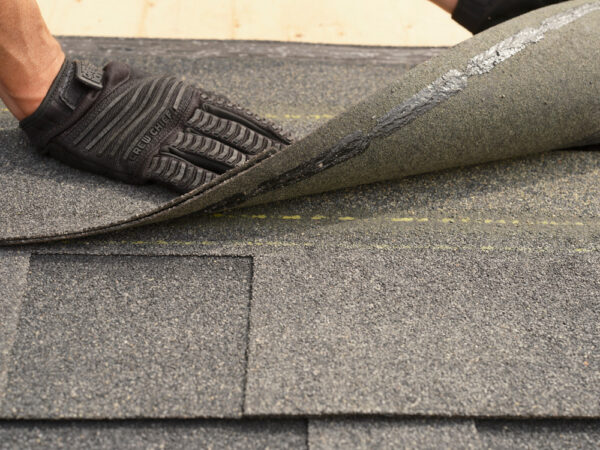
Every asphalt shingle leaves the factory with a narrow adhesive strip—often called the self‑seal strip. When the sun warms a new roof, that strip bonds each shingle to the one below. That bond is your shingle’s anchor against gusts and storms. If it’s too cold, dusty, shaded, foggy/marine‑layer cool, or the roof is very steep, the strip may not activate quickly, tabs can flutter, and a “peel‑and‑tear” chain reaction can start in high winds. Manufacturers and independent labs all warn that in these conditions, you should add hand‑applied tab‑to‑tab sealant during installation. (1)
Sun + Asphalt = Bond: How the Strip Activates
The strip is an asphalt‑based adhesive engineered to soften and tack with heat from direct sunlight, then harden into a durable bond. It’s small, but it dramatically boosts wind resistance by preventing shingles’ leading edges from lifting. (1)
Industry wind ratings (e.g., ASTM D7158 Class D/G/H) are achieved after that seal is activated under lab conditions; cold or dusty jobsites delay sealing. (2)(3)
Do Some Brands Have “Better” or More Durable Seal Strips?
Each major brand markets its seal strip chemistry a bit differently. GAF has its Dura Grip adhesive, CertainTeed (CertaSeal), and Owens Corning (Tru-Bond). However, there isn’t a credible, peer‑reviewed, head‑to‑head ranking that proves one brand’s self‑seal strip is consistently “more durable” than all others. What you can compare reliably are each shingle’s wind‑resistance classifications (ASTM D7158/D3161) and the manufacturer’s installation guidance—and on those fronts, many flagship products across major brands end up with the same top ratings when the factory seal has activated. In plain terms, when shingles are properly installed and the strip gets warm enough to bond, performance converges; problems arise when the strip hasn’t sealed (cold, dust, shade, marine fog) or later becomes unsealed with age. (4)(5)
What the Research Shows
Over the last decade, lab and full‑scale wind‑tunnel work has converged on the same theme: asphalt shingles resist storms mainly when the tab‑to‑tab seal is intact, and that seal’s behavior depends on temperature, contamination (dust/sand), geometry, and installation details. The Insurance Institute for Business & Home Safety (IBHS) showed that cold‑weather or steep‑slope installs reduce uplift resistance unless installers hand‑seal—a point echoed by The Asphalt Roofing Manufacturers Association’s (ARMA) guidance—and that the strength of the adhesive bond is the single most important factor in high‑wind performance. (2)(6)
Florida International University’s Wall of Wind studies pushed this further at full scale, documenting how corner zones and edges see the harshest suction and how shingles fail progressively once a leading‑edge seal starts to separate; their 2022 and 2023 papers also argued that today’s standard tests don’t fully capture real‑roof loading in those critical areas. (7)
Complementing those system‑level tests, engineering journals have drilled into the seal itself: Croom et al. (8) developed a shingle‑and‑sealant model and found that strip length and placement can lower the energy‑release rate driving delamination; Rajan et al. (9) used stereo digital image correlation to show single vs. double seal strips change the uplift deformation field and that tab cutouts (three-tab shingles) become likely initiation sites; Ghorbani et al. (10) documented progressive failure mechanics on full‑scale panels; and Cui et al. (11) provided material‑modeling evidence that shingle structural response (and thus sealing demands) varies with microstructure and loading rate. Together with IBHS’s observation that polymer‑modified shingles can better retain performance, the literature points to a practical takeaway for homeowners: pick a top‑class shingle, but assume you’ll need hand‑sealing whenever sun/heat are marginal or wind‑blown dust is present, because ratings presume a fully sealed strip.
Here’s Why the Ratings Don’t Settle the “Which Brand Seals Better” Debate:
Ratings apply to sealed shingles. ASTM D7158/D3161 classifies sealed shingles—D, G, H, or A, D, F—under defined lab conditions. Multiple products from GAF, Owens Corning, CertainTeed, IKO, TAMKO, PABCO, etc., reach the top class on their premium lines. The standards do not score how quickly or reliably a strip seals on a cold, dusty, foggy, or shaded roof. (4)(5)
Independent research focuses on mechanics, not brand shoot‑outs. Modern studies from IBHS and FIU’s Wall of Wind show that the strength of the seal at the leading edge is the dominant factor in resisting wind uplift—but these papers either use anonymized or generic shingles, or study sealant mechanics, geometry, and installation—not brand labels. (2)(7)
Manufacturers agree on the “when to hand‑seal” list. ARMA and brand bulletins all direct installers to hand‑seal in cold weather, on steep/mansard slopes, and in dusty/windy conditions—because the factory strip may not activate promptly. That near‑universal guidance is itself a signal that site conditions, not logos, drive early‑life performance.
How Northern California Microclimates Affect Sealing
Lake Tahoe (Alpine)
Winter lows routinely fall below freezing; even many autumn/spring mornings start sub‑40°F. Sealant activation is slow on shaded/north slopes; freeze–thaw cycles are common. A low‑temperature‑flexible adhesive can help, but hand‑sealing on steep or shaded faces is still standard best practice.
Sacramento (Valley heat & dust)
Long, hot, sunny summers (~93°F average highs in July), so sealing is typically rapid—but wind‑blown dust during the dry season can contaminate the strip and delay or weaken the bond. Keep decks clean; in windy/dusty installs, hand‑seal critical edges.
Bay Area (Marine layer & micro‑climates)
Cool summers, frequent fog/marine layer, and wind near the coast limit direct solar heating, so seals can take longer to set—especially on north slopes or under trees. Inland East/North Bay areas seal faster during heat waves; coastal hills and headlands can see strong gusts. In fog belts, hand‑sealing exposed edges and any shaded areas is wise.
Turn “When” and “How” into “Where” to Fortify Your Roof
The last decade of research lines up cleanly with job-site common sense. Lab and full‑scale testing show how shingles fail in wind: once a leading‑edge seal lifts—especially at edges and corners—suction spikes and damage spread from one tab to the next. Installation standards and manufacturer bulletins tell us when the factory self‑seal may not bond quickly: cold weather, persistent shade, marine fog, dust/sand, steep or mansard slopes, and wind‑exposed rakes. Put those together and a clear map of where to reinforce emerges: rakes and eaves (especially windward edges), gable ends, hips/ridges, courses flanking valleys and dormers, around penetrations (vents, stacks, skylights), and any north‑facing or tree‑shaded slopes installed in marginal temperatures. In those zones, adding hand‑applied, quarter‑size dabs of ASTM‑compliant roofing cement under the tabs bridges the gap between lab assumptions and your real microclimate—so your roof is sealed now, not “once it finally warms up.”
For a tailored plan that matches your home’s exposure—from Tahoe cold to Sacramento dust to Bay‑area fog—we are your local roofing company, GOOD ROOF WORX, and offer a free in‑house consultation on your next roofing replacement project.
References
1. Asphalt Roofing Manufacturers Association. (2017, May). Recommendations for application of asphalt shingles on slopes greater than 21:12 [Technical bulletin]. https://www.asphaltroofing.org/wp-content/uploads/2017/05/ARMA-Technical-Bulletin-Asphalt-Shingles-on-Slopes-Greater-than-21-12.pdf. (asphaltroofing.org)
2. Smith, H. E. E. J., & Brown-Giammanco, T. M. (n.d.). Wind uplift of asphalt shingles: Sensitivity to roof slope and installation temperature. Ibhs.org. Retrieved from https://ibhs.org/wp-content/uploads/member_docs/Wind-Uplift-of-Asphalt-Shingles_IBHS.pdf
3. Roof Wind Damage. (n.d.). Owenscorning.com. Retrieved from https://www.owenscorning.com/en-us/roofing/blog/understanding-asphalt-roofing-shingles-wind-resistance
4. Graham, M. S. (2021, February 1). Understanding asphalt shingle standards. Professionalroofing.net. https://www.professionalroofing.net/Articles/Understanding-asphalt-shingle-standards–02-01-2021/4817
5. Standard test method for wind resistance of asphalt shingles (uplift force/uplift resistance method). (2024, February 15). Astm.org. Retrieved from https://store.astm.org/d7158_d7158m-20.html
6. Recommendations for Installation of Asphalt Roofing Shingles in Cold Weather (2022, March). Atlasroofing.com. Retrieved from https://www.atlasroofing.com/img/Literature/ARMA_-_Recommendations_for_Installation_of_Asphalt_Shingles_in_Cold_Weather.pdf
7. Tolera, A. B., Mostafa, K., Chowdhury, A. G., Zisis, I., & Irwin, P. (2022). Study of wind loads on asphalt shingles using full-scale experimentation. Journal of Wind Engineering and Industrial Aerodynamics, 225(105005), 105005. https://doi.org/10.1016/j.jweia.2022.105005
8. Croom, B. P., Sutton, M. A., Zhao, X., Matta, F., & Ghorbani, R. (2015). Modeling of asphalt roof shingle-sealant structures for prediction of local delamination under high wind loads. Engineering Structures, 96, 100–110. https://doi.org/10.1016/j.engstruct.2015.03.063
9. Rajan, S., Myers, T., Sutton, M. A., Boozer, M., Kidane, A., Ghorbani, R., & Matta, F. (2022). Full-field shingle uplift measurements using StereoDIC: Comparison of single and double sealant three-tab shingle responses when subjected to hurricane velocity winds. Journal of Wind Engineering and Industrial Aerodynamics, 224(104861), 104861. https://doi.org/10.1016/j.jweia.2021.104861
10. Ghorbani, R., Matta, F., Sutton, M. A., Liu, Z., Reinhold, T., Cope, A., & Rajan, S. (2023). Progressive failure of asphalt shingles under high winds: Assessment via full-field deformation measurements on full-scale roof panels. Journal of Wind Engineering and Industrial Aerodynamics, 243(105607), 105607. https://doi.org/10.1016/j.jweia.2023.105607
11. Cui, Q., Hurtubise, C., Smith, S., & Yang, J. (2023). Asphalt shingle modeling and parameter estimation under short period loading condition. Construction and Building Materials, 364(129966), 129966. https://doi.org/10.1016/j.conbuildmat.2022.129966
Leave a Reply