
By Max D., MBA | GOOD ROOF WORX
Know how roofs fail to prepare for smarter replacement. See why edge detailing matters most against wind so your next roof replacement is engineered to last.
When wind damages a shingle roof, it almost never starts in the middle. It starts at the edges—the eaves (bottom edges) and rakes (gable edges)—then rips its way inward. That isn’t a hunch; it’s what full‑scale wind labs, standards organizations, and post‑storm investigations have repeatedly measured. The good news: edge failures are predictable and preventable with the right products and installation steps. (1)(2)
The Science—Why the Edges Go First
As wind flows over your roof, it separates at the windward edge and forms powerful corner vortices that cause the greatest suction (uplift) at perimeters and corners. Think of a tiny, invisible whirlpool grabbing the leading edge of each shingle tab. Peak suctions at these locations can be far higher than loads over the “field” (middle) of the roof, which is why design standards treat corners and perimeters as special roof zones with higher required resistance. (3)(4)
Modern asphalt shingles rely on a self‑sealing adhesive strip to bond each course to the one below. IBHS testing has shown the strength and activation of that seal is the single most important factor in resisting wind uplift. If the seal never activates (cold, shaded, dusty installs) or unseals later with aging or contamination, wind can get under the tab and start a peel‑and‑tear sequence. StereoDIC (full‑field deformation) studies show how initial peel at the edge progresses across the tab until the shingle fails. Doubling the sealant line or reinforcing the nail zone limits that deformation and delays failure. (2)(5)
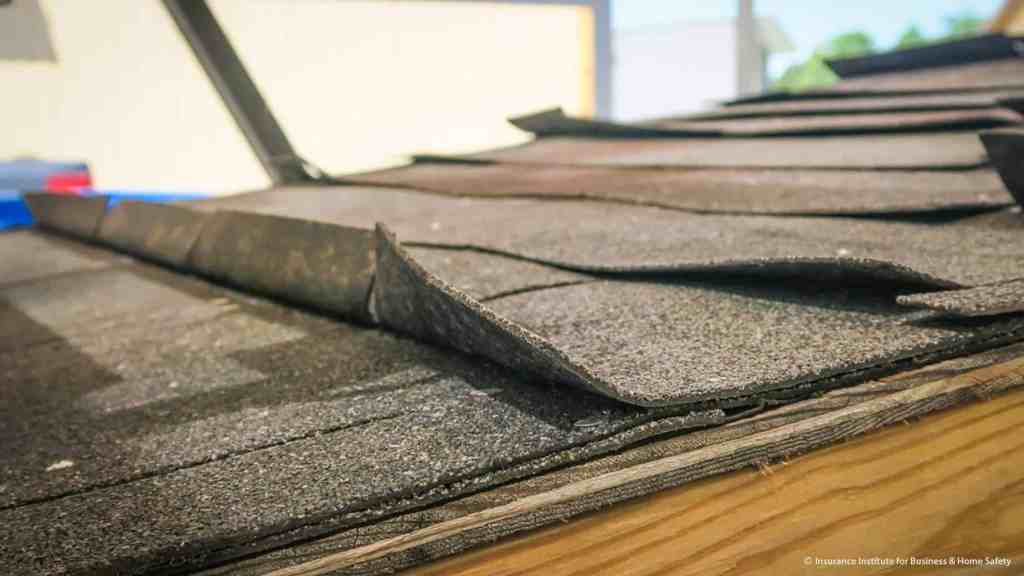
Recent peer‑reviewed work sharpens this picture. Using high‑speed full‑field measurements paired with computer fluid‑dynamics, researchers show that once a shingle tab at a rake or eave begins to peel, the tab’s changing shape actually intensifies local suction, accelerating uplift; shingles that use dual sealant lines or reinforced nail zones measurably limit those edge deformations and delay failure. At the same time, improved peak‑pressure methods confirm that the largest, most damaging pressure spikes occur where corner vortices and low‑frequency gusts focus—perimeters and corners—not in the roof field. And when a tiny opening forms near a gable or rake, internal pressure rises and “pries” the next tabs, turning a small defect into a cascading blow‑off. In short: peaks are highest at edges, openings magnify them, and stronger seals suppress the start of that sequence—exactly why edge detailing and seal activation make or break real‑world performance. (6)(7)(8)(9)
A Simple Way to Picture What the Wind is Doing
Your shingle roof isn’t airtight. There’s a paper‑thin gap under each shingle, so a little air can slip in. When wind blows over the roof, some of that outside air sneaks under the shingles and evens out the push and pull. With the pressure more balanced above and below, the shingle feels less upward tug. Engineers call that balancing act pressure equalization.
Now the catch: that helpful effect mostly works in the middle of the roof, where each shingle is surrounded and sheltered by others. At the edges—the eaves and rakes—or anywhere there’s a gap (like a tab that hasn’t sealed), the wind grabs a clean lip. Air can rush in and whip out, and the pressure can’t balance. You get a strong “vacuum” right at that edge, the upward pull spikes, and that’s where lifting and tearing start.
Bottom line: Wind creates the highest suction at edges; if the tab‑to‑tab seal and the edge detailing aren’t right, uplift initiates there and propagates across the roof.
Northern California Roof Resilience
Not all Bay Area and Sierra roofs face the same wind. Terrain, canyons, coastlines, and cold valleys change how air moves over a home—and where uplift strikes first. Use this guide to see what a resilient roof replacement should include in San Jose and Silicon Valley, the San Francisco Peninsula and City, the East Bay hills, the North Bay, the Sacramento Valley and Foothills, and Lake Tahoe/Truckee. The theme is constant: edges first. Get the eaves, rakes, hips, ridges, and valleys right, and you’ve solved most of the problem.
South Bay / Silicon Valley (San Jose, Santa Clara, Sunnyvale, Cupertino, Mountain View, Palo Alto)
Valley neighborhoods experience episodic Diablo wind spill‑outs and strong winter storm gusts that wrap around the Santa Cruz Mountains. Two‑story gables common in Silicon Valley create tall windward rakes and corners where suction concentrates. Tree‑lined streets also shade roof edges, which can delay sealant activation after installation.
Peninsula & San Francisco Coastal Exposure (San Mateo, Pacifica, Daly City, the west side of San Francisco)
Long‑duration marine gap winds and winter atmospheric river events drive persistent gusting with high turbulence. Coastal air also increases corrosion risk for exposed metals at the perimeter.
East Bay Hills & the Diablo Range (Fremont, Hayward, Oakland, Berkeley, Walnut Creek, Concord and ridgeline communities)
Downslope Diablo winds accelerate through canyons and over ridgelines, creating intense corner vortices and suction peaks at rakes and eaves. Steeper roof pitches are common on hillside lots, which raises the threshold for sealant activation in cooler months.
North Bay & Coastal Ranges (Marin, Petaluma, Santa Rosa, Napa and rural ridge communities)
Ridge tops and high valleys can see 80–100+ mph gusts in powerful winter systems. Many homes combine long ridgelines with large gable ends—great for views, tough on roofing edges.
Sacramento Valley & Foothills (Sacramento, Elk Grove, Folsom, Roseville, Auburn and surrounding communities)
Winter storms bring widespread 30–45 mph gusts and long periods of southerly winds. Many neighborhoods have long, open fetch across parks and greenbelts that focus wind onto gable rakes and corners. Leaf‑littered valleys and gutters compound water entry when tabs lift.
Lake Tahoe / Truckee & Sierra Neighborhoods
Frequent ridge gusts near triple‑digit speeds meet cold‑weather installation challenges. Steep pitches and snow/ice increase the time it takes for self‑seal adhesives to bond, leaving tabs vulnerable unless crews plan for it.
What does a resilient, wind‑smart roof look like in your region? We are your local roofing company, GOOD ROOF WORX, feel free to reach out for a free inspection and in‑home consultation on your roof replacement.
References
1. Tolera, A. B., Mostafa, K., Chowdhury, A. G., Zisis, I., & Irwin, P. (2022). Study of wind loads on asphalt shingles using full-scale experimentation. Journal of Wind Engineering and Industrial Aerodynamics, 225(105005), 105005. https://doi.org/10.1016/j.jweia.2022.105005
2. Estes, H. E., Smith, J. T., & Brown-Giammanco, T. M. (2017, April). Wind uplift of asphalt shingles: Sensitivity to roof slope and installation temperature. Insurance Institute for Business & Home Safety. https://ibhs.org/wp-content/uploads/member_docs/Wind-Uplift-of-Asphalt-Shingles_IBHS.pdf(ibhs.org)
3. Taylor, Z., Morrison, M., Gurka, R., & Kopp, G. (2009). Turbulent flow over a house in a simulated hurricane boundary layer. In arXiv [physics.flu-dyn]. https://doi.org/10.48550/ARXIV.0910.3219
4. Federal Emergency Management Agency. (2022, August). Highlights of significant changes to the wind load provisions of ASCE 7-22 [Fact sheet]. https://www.fema.gov/sites/default/files/documents/fema_asce-7-22-wind-highlights_fact-sheet_2022.pdf(fema.gov)
5. Ghorbani, R., Matta, F., Sutton, M. A., Liu, Z., Reinhold, T., Cope, A., & Rajan, S. (2023). Progressive failure of asphalt shingles under high winds: Assessment via full-field deformation measurements on full-scale roof panels. Journal of Wind Engineering and Industrial Aerodynamics, 243(105607), 105607. https://doi.org/10.1016/j.jweia.2023.105607
6. Myers, T., Sutton, M. A., Rajan-Kattil, S., Farouk, T., Chao, Y. J., Boozer, M., & Kidane, A. (2023). A hybrid experimental-computational study: Prediction of flow fields and full-field pressure distributions on measured shapes of three-tab asphalt roofing shingles subjected to hurricane velocity winds. Forces in Mechanics, 11(100193), 100193. https://doi.org/10.1016/j.finmec.2023.100193
7. Rajan, S., Myers, T., Sutton, M. A., Boozer, M., Kidane, A., Ghorbani, R., & Matta, F. (2022). Full-field shingle uplift measurements using StereoDIC: Comparison of single and double sealant three-tab shingle responses when subjected to hurricane velocity winds. Journal of Wind Engineering and Industrial Aerodynamics, 224(104861), 104861. https://doi.org/10.1016/j.jweia.2021.104861
8. Yuan, Y., Dai, Y., Jiang, S., & Liu, T. (2021). Experimental and theoretical study on the internal pressure induced by the transient local failure of low-rise building roofs. Advances in Structural Engineering, 24(14), 3222–3237. https://doi.org/10.1177/13694332211022069
9. Fernández-Cabán, P. L., Masters, F. J., & Phillips, B. M. (2018). Predicting roof pressures on a low-rise structure from freestream turbulence using artificial neural networks. Frontiers in Built Environment, 4. https://doi.org/10.3389/fbuil.2018.00068
10. Miller, C. S., & Kopp, G. A. (2024). A framework for design wind loads on air-permeable multilayer cladding systems. Frontiers in Built Environment, 10. https://doi.org/10.3389/fbuil.2024.1398472
Leave a Reply